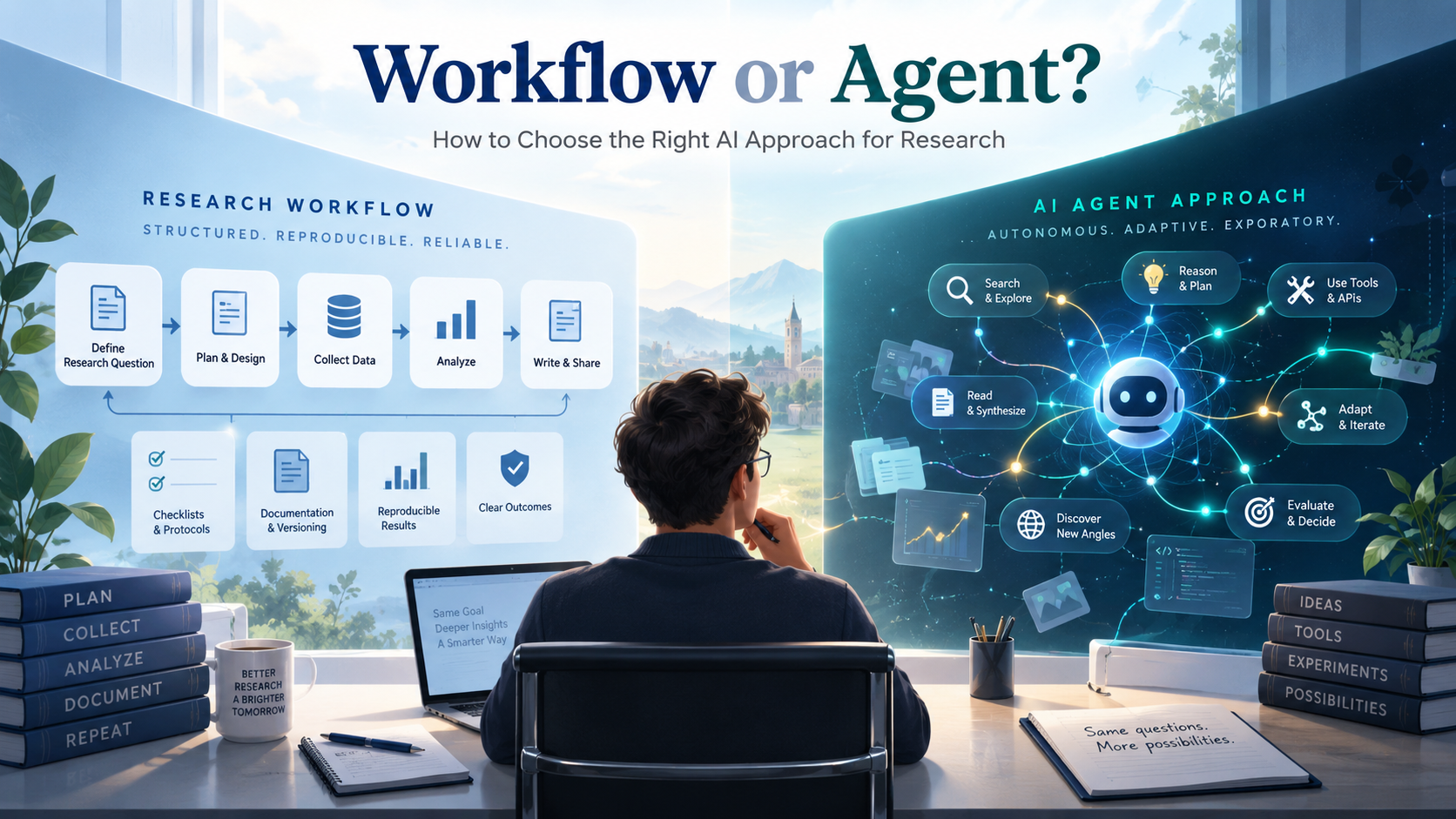
Should your AI research assistant follow a predefined workflow, or should it decide what to do next?
Consider two tasks. In the first, you need to extract the same information from a collection of papers and produce a consistent evidence table. In the second, you are investigating an unfamiliar problem and do not yet know which concepts, sources, or methods will matter.
Both involve research. But they call for different kinds of automation.
Choose AI workflows when the research process is well defined and needs consistent execution. Choose AI agents when deciding the next step is itself part of the task. When a project contains both, use a workflow to govern the process and bounded agents to explore within it.
The important question is not which approach sounds more advanced. It is which decisions should be predetermined, which can be delegated, and which must remain under human control.
This guide compares AI workflows and AI agents, explains their advantages and limitations, and offers practical recommendations for literature reviews, data analysis, hypothesis development, and academic writing.
What Is the Difference Between an AI Workflow and an AI Agent?
The distinction is primarily about control over the next action, not the intelligence of the underlying model.
Anthropic’s architectural distinction is useful: workflows organize models and tools through predefined execution paths, while agents allow models to direct their own processes and tool use dynamically. Both can use powerful language models, external information, and computational tools. Anthropic
What is an AI research workflow?
An AI research workflow is a designed process in which tasks, transitions, and checkpoints are specified in advance.
For example, you might design this process:
Import papers → extract study characteristics → validate required fields → review uncertain entries → generate an evidence table.
The model may perform difficult reasoning within an individual stage. However, it does not have unrestricted authority to replace the overall process.
A workflow does not have to be a rigid, one-way sequence. It can include branches, parallel tasks, feedback loops, and revision stages. The defining feature is that the surrounding system specifies how these mechanisms operate. LangGraph’s documentation, for example, distinguishes predetermined workflow paths from agents that dynamically determine their processes and tools. Docs by LangChain
What is an AI research agent?
An AI research agent receives an objective and selects actions based on what it discovers.
Imagine asking an agent to investigate why two studies report apparently contradictory results. It might inspect the papers, compare populations, locate supplementary materials, investigate measurement differences, and decide that additional searches are necessary.
Its next action depends on intermediate findings rather than only on a predefined sequence. An agent can still have restricted tools, stopping conditions, and human checkpoints; autonomy does not require unrestricted access or unlimited execution. Anthropic
Are workflows and agents mutually exclusive?
No. These terms describe architectural choices, not two incompatible categories of software.
A workflow can contain an agentic research stage. An agent can invoke a predefined analysis workflow. A system can also permit dynamic decisions in one stage while enforcing fixed rules in another.
For selection purposes, ask a concrete question:
Can the model change what happens next, and how far does that authority extend?
That is more informative than a product’s use of labels such as “autonomous,” “agentic,” or “AI-powered.”
AI Workflows vs. AI Agents: A Practical Comparison
The following comparison describes design tendencies, not universal performance rankings. Actual results depend on implementation, model quality, tool access, and evaluation.
| Dimension | Workflow-oriented approach | Agent-oriented approach |
|---|---|---|
| Control | The system defines the permitted paths and transitions. | The model chooses actions within its assigned boundaries. |
| Unexpected findings | Requires an appropriate branch, exception route, or human intervention. | Can select additional actions in response. |
| Consistency | Makes a common procedure easier to enforce. | Can follow different paths across otherwise similar tasks. |
| Inspection | Defined stages provide natural places to inspect intermediate outputs. | Inspection must also account for dynamically selected actions. |
| Resource planning | Bounded stages make resource limits easier to specify. | Search depth and iteration require explicit limits. |
| Main design challenge | Anticipating enough of the task structure without overconstraining it. | Giving useful freedom without losing control of scope. |
These differences follow from how workflows and agents organize execution; neither architecture automatically makes its outputs correct. Docs by LangChain
A useful distinction is between procedural predictability and scientific validity. A system can follow a process consistently while applying the wrong method. It can also take a flexible path and reach a well-supported conclusion.
The goal is to achieve both appropriate execution and defensible results.
When AI Workflows Are the Better Choice
My recommendation is to favor workflows when you can describe a defensible procedure before the system starts.
Repeated tasks with a stable structure
Consider a research team that repeatedly needs to turn approved study records into evidence summaries.
A sensible workflow might require the same fields, preserve source locations, flag missing information, and prevent synthesis until extraction has been reviewed.
The benefit is not simply speed. It is that the team can decide what a complete record looks like and make that expectation explicit.
This is particularly useful for data collection. The Cochrane Handbook emphasizes accurate, complete, accessible data and transparent extraction methods; it also describes the value of structured data systems and links between extracted items and their locations in study reports. Cochrane
Tasks where intermediate outputs need approval
A workflow is a natural choice when progress should depend on a meaningful decision.
For example, a team might require approval of the research question before searching, approval of the extraction table before analysis, and approval of the results before drafting conclusions.
These checkpoints should inspect research artifacts, not merely ask someone to click “Continue.”
A useful approval screen would show what changed, what remains uncertain, and which evidence supports the proposed next step.
Processes that need controlled updates
For recurring work, I would separate the stable procedure from changing inputs.
A monthly evidence update, for example, might reuse the same eligibility rules and extraction schema while adding newly retrieved records. Exceptions would enter a review queue rather than silently changing the process.
That design makes it easier to ask whether a changed conclusion comes from new evidence or from an altered method.
Where workflows can fail
The main danger is encoding the wrong assumptions too early.
Suppose a workflow requires every study to report an intervention and a control group. That structure may be appropriate for one review but inappropriate for a collection of ethnographic studies.
A workflow can also make revision expensive when every new research direction requires redesigning the surrounding process.
The solution is not to eliminate structure. It is to distinguish genuine methodological requirements from convenient defaults, and to provide explicit routes for exceptions and amendments.
A well-designed workflow standardizes what should remain consistent without pretending that all research follows the same template.
When AI Agents Are the Better Choice
My recommendation is to use agents when the route to the answer cannot be specified reliably in advance, but useful intermediate feedback is available.
Open-ended information gathering
An exploratory investigation may reveal unfamiliar terminology, competing explanations, or an unexpected connection to another field.
An agentic approach can make sense because later searches should depend on earlier findings. Anthropic’s account of its research system describes this dynamic search pattern and the use of separate agents to pursue different aspects of a question. This is an engineering example, not evidence that agents outperform workflows on every research task. Anthropic
For your own project, define the deliverable carefully: a map of concepts, a set of competing explanations, or a documented collection of candidate sources—not an unsupported declaration that the topic has been exhaustively researched.
Tasks with informative feedback
Agents are especially worth considering when actions produce feedback that can guide the next attempt.
For a computational task, that might include a failed test, an incompatible data schema, or a discrepancy between an expected result and an observed output.
The research team can then specify what counts as success and evaluate whether the agent reaches it. Anthropic’s tool-design guidance similarly recommends realistic evaluation tasks paired with verifiable responses or outcomes. Anthropic
Where agents can fail
Adaptive execution creates additional ways to go wrong.
An agent might pursue an interesting but irrelevant branch, continue searching after it has enough evidence, or spend effort looking for information that does not exist. Anthropic reports encountering excessive searching, duplicated work, and poor delegation while developing its multi-agent research system. Anthropic
For researchers, the more consequential concern is unauthorized methodological change.
An agent should not quietly narrow eligibility criteria because the original search returned too much material, or substitute a different outcome because it is easier to extract.
Give agents freedom to investigate uncertainty—not permission to hide changes in the research question.
Which Approach Fits Different Research Tasks?
A project does not need one architecture from beginning to end. The following recommendations separate common research situations by the kind of judgment they require.
Exploring an unfamiliar field: start with a bounded agent
For an initial orientation exercise, I would begin with an agent that can revise queries and follow promising connections.
A useful assignment would ask it to identify major concepts, explain terminology differences, distinguish established findings from contested claims, and return a source-backed map of the field.
Set boundaries around scope, effort, and the expected output. Ask it to record unanswered questions rather than fill every gap with a confident explanation.
Importantly, an exploratory literature scan should not be confused with a formal scoping review. Formal evidence syntheses have reporting and methodological expectations beyond producing a broad overview; PRISMA-S explicitly addresses searches across several types of evidence synthesis, including scoping reviews. DOI
Recommended approach: agent-led exploration followed by human refinement of the research question.
Systematic reviews and meta-analyses: use a workflow as the governing structure
For a systematic review, I would make the protocol and review process authoritative.
Cochrane guidance describes systematic and comprehensive study identification, including search planning, source selection, documentation, and eligibility assessment. These are not decisions that should disappear inside an uninspectable search session. Cochrane
Agents can still assist with bounded tasks: proposing search terms, locating supplementary reports, or flagging possible discrepancies. But proposed changes to eligibility criteria or synthesis methods should require explicit review.
Preserve the actual search strategies, information sources, dates, and update methods. PRISMA-S provides reporting guidance for these details, including reporting search strategies as executed and documenting changes. DOI
For meta-analysis, I would also require reviewed extraction data and tested statistical routines before generating interpretive prose.
PRISMA 2020 is a reporting guideline—not a certificate that the search, included studies, or analysis are valid. A flow diagram cannot substitute for a defensible review process. PRISMA statement
Recommended approach: workflow-led execution with bounded agent assistance and methodological approval gates.
Developing hypotheses or new methods: use agents to expand options
For early-stage idea development, I would use an agent to generate and challenge alternatives rather than force immediate convergence.
An illustrative assignment might be:
Propose competing explanations for this observation. For each explanation, identify supporting evidence, contradictory evidence, assumptions, and a feasible way to distinguish it from the alternatives.
The desired output is a set of inspectable possibilities.
I would not ask the agent to “prove this idea is novel.” Instead, require it to document the closest work it found and the remaining uncertainty. Failure to locate a predecessor is not a logical demonstration that none exists.
Once a promising direction has been selected, move toward a more structured plan.
Recommended approach: agent-supported exploration, human selection, then a workflow for execution.
Data analysis and computational experiments: separate development from confirmation
For analysis development, an agent may be useful for inspecting unfamiliar files, proposing code changes, or investigating a failed implementation.
For repeated execution of an approved analysis, I would prefer a versioned workflow with saved inputs, explicit parameters, and tested code.
The crucial boundary is between exploration and confirmation. The Center for Open Science explains preregistration as a way to distinguish planned analyses from unplanned work and make that distinction transparent. Center for Open Science
For example, an agent might help explore alternative transformations during development. It should not silently try many alternatives, select the most favorable result, and present that result as though it came from the original confirmatory plan.
Preserve exploratory attempts and clearly label deviations.
Also distinguish two questions: “Does the code execute as intended?” and “Is this analysis scientifically appropriate?” Passing a software test answers only what that test was designed to check.
Recommended approach: agent-assisted development, workflow-controlled execution, and human review of analytical assumptions.
Qualitative, humanities, and mixed-methods research: use a human-led hybrid
For interpretive research, I would avoid both extremes: a rigid universal template and an agent with unrestricted authority over interpretation.
Instead, use a workflow to preserve materials, annotations, codebook versions, and analytical decisions. Use agents to propose comparisons, surface potentially relevant passages, or offer competing readings.
Imagine a study comparing interview accounts of workplace change. An agent could suggest that several passages share a theme. The researcher should still determine whether that theme respects context, captures meaningful differences, and fits the study’s analytical approach.
An evolving interpretation need not mean an undocumented process.
Recommended approach: structured recordkeeping with agent-assisted exploration and researcher-led interpretation.
Academic writing: structure the evidence before delegating the prose
For writing from completed research, I would use a workflow that starts with approved findings and source-backed claims.
A practical sequence is:
Approved evidence → section objectives → draft → claim verification → numerical checks → human revision.
An agent can play a bounded critical role by looking for unsupported transitions, alternative explanations, or literature that challenges the argument.
It should not invent an experiment to complete a Methods section or turn missing evidence into an apparently finished result.
Generative systems can produce false content and fabricated citations, including explanations that appear to justify an incorrect answer. NIST identifies these as confabulation risks. Consequently, fluent prose should not be treated as evidence of factual reliability. NIST Publications
Recommended approach: workflow-based drafting from verified materials, with agents used for critique and targeted investigation.
Cost and Speed: Compare the Cost of a Verified Result
The cheapest generation is not necessarily the cheapest usable research output.
For selection purposes, I suggest comparing:
Total validated cost = model and tool spending + setup and maintenance + human checking + rework.
Treat this as a decision framework, not a standardized accounting formula.
A workflow might be economical for a repeated task but expensive to build for a one-off investigation. An agent might save substantial manual exploration while producing more material that needs checking.
Agentic execution can also consume substantial resources. In its own research-system deployment, Anthropic reported higher token consumption for agents and multi-agent systems than for ordinary chat. Those observations concern that particular system and baseline; they are not a universal multiplier or a direct workflow-versus-agent cost comparison. Anthropic
For a fair comparison, give both approaches equivalent source access and apply the same quality standard. Measure time to an accepted result—not merely time until a report appears.
A useful question is:
How much researcher attention does this approach require before the output can be trusted for its intended purpose?
Reproducibility, Evidence, and Safety Matter in Both Approaches
A fixed workflow does not guarantee identical or correct outputs
Controlling the sequence of operations is different from controlling every input and outcome.
Research records should preserve enough information to inspect what happened: source versions where available, retrieved records, extraction decisions, code, parameters, and amendments.
For AI systems, I would also retain relevant model identifiers, prompts, tool settings, and execution logs, subject to privacy requirements.
The aim is not simply to repeat the same button click. It is to make consequential steps understandable and checkable.
An agent can use reproducible components
Agentic execution and tested computation can coexist.
An instructive example is Paper2Agent, published in Nature in 2026. Its design turns research materials and code into tools that agents can invoke. The authors describe validating tools against reference code and reported results, then locking the validated implementations. Nature
The design lesson is narrower than “agents are reproducible.” It is that a flexible decision-making layer can operate over controlled, tested components.
For your own system, this suggests a useful boundary: allow the agent to choose an approved operation without automatically allowing it to rewrite that operation.
Permissions matter more than labels
Do not assume that a workflow is safe because it is structured, or that an agent needs access to every available resource.
For sensitive work, examine what information the system can read, where it can send data, and which actions require approval.
External documents and webpages can contain malicious instructions that attempt to redirect an AI system. Anthropic’s browser-agent research describes this prompt-injection risk and emphasizes that it remains unresolved. Anthropic
My default would be read-only access for discovery, isolated environments for code execution, and explicit approval before destructive or externally visible actions.
How to Design a Hybrid Research Process
A hybrid approach is not simply “add an agent somewhere.” It needs a clear division of authority.
Consider this proposed process:
Define the question → approve the plan → investigate evidence → validate findings → synthesize → review.
The workflow governs the stages. Agents receive scoped assignments within them.
For example, an evidence-gathering agent could be allowed to revise search queries, inspect supplementary materials, and investigate contradictions. It would not be allowed to change the approved population or silently remove inconvenient findings.
Before advancing, require an inspectable handoff: sources consulted, findings supported by those sources, unresolved issues, and proposed amendments.
This approach has its own disadvantages. You must design the boundaries, manage handoffs, and decide what happens when an agent’s proposal conflicts with the current plan. Too many approval gates can also make the system cumbersome.
For that reason, I would not build an elaborate hybrid for a trivial task. Use it where both adaptability and methodological control have clear value.
Let the workflow determine what must be accounted for. Let the agent help determine how to investigate what remains unknown.
How to Evaluate a Research Workflow or Agent Before Adopting It
Do not choose from a polished demonstration alone.
Prepare representative tasks with independently checked reference materials. Include routine cases, ambiguous cases, missing information, and tasks where the appropriate outcome is to report uncertainty.
Anthropic’s agent-evaluation guidance recommends evaluating research outputs through supported claims, coverage, source quality, and expert-calibrated judgment. It also notes that behavior can vary between runs. Anthropic
The following is a proposed evaluation rubric for a research team:
| Evaluation area | What to examine |
|---|---|
| Evidence support | Does the cited source actually support the associated claim, rather than merely exist? |
| Retrieval coverage | On a test set with known relevant material, what important evidence was missed? |
| Extraction accuracy | Do values, study characteristics, and source locations match the originals? |
| Method adherence | Were eligibility rules, analysis choices, and approved boundaries respected? |
| Uncertainty handling | Did the system distinguish missing information, ambiguity, and verified findings? |
| Repeat-run stability | Do repeated attempts produce materially consistent conclusions and acceptable variation? |
| Total effort | How much time, spending, checking, and correction were required? |
For retrieval evaluation, be explicit about the reference set. Coverage against a known test collection is not proof of exhaustive coverage of the entire literature.
Also include negative tests: a missing statistic should remain missing, a nonexistent source should not be invented, and a task outside the approved scope should trigger clarification or escalation.
Finally, evaluate the system you will actually use. A model name alone does not describe its prompts, tools, permissions, retrieval access, or execution framework.
Frequently Asked Questions
Are AI agents better than AI workflows for research?
Not inherently. I recommend agents when the next action depends on discoveries made during the task, and workflows when an established procedure needs controlled execution. Select at the task level rather than assigning one architecture to an entire project.
Can an AI workflow contain an agent?
Yes. A predefined workflow can delegate a stage to an agent, then require a structured output before proceeding. Conversely, an agent can invoke an established workflow as one of its available operations.
Are workflows more accurate than agents?
Neither label establishes accuracy. A fixed process can repeat an error, while an adaptive process can arrive at a supported result. Compare the actual implementations against the same reference tasks and acceptance criteria.
Can an AI agent conduct a systematic review?
I would use an agent to support defined parts of the review, not treat an autonomous report as sufficient evidence that a systematic review was conducted. Require a defensible protocol, documented searches, inspectable decisions, verified extraction, and appropriate synthesis.
Should researchers use multiple agents?
Only where there is a clear reason to divide the work. For example, separate investigations of distinct evidence sources may justify parallel agents. I would not treat agreement between several AI outputs as a substitute for checking the underlying evidence.
Which approach should a beginner choose?
Start with a narrow task whose output you can verify. My recommendation is a guided workflow for an established procedure, or a tightly bounded agent for an exploratory question. Expand autonomy only after you understand the system’s failure modes.
Final Recommendation: Choose the Right Boundary for Autonomy
The workflow-versus-agent debate becomes more useful when translated into decisions about authority.
For a known procedure, use a workflow to make requirements explicit.
For an uncertain route, use an agent to investigate possibilities within clear limits.
For work that combines both, use a hybrid—but keep methodological changes visible and subject to appropriate review.
Researchers remain responsible for the work they present. Springer Nature’s AI policy, for example, explicitly retains human responsibility for scholarly judgment and accountability. Nature
The best AI research system is not the one that acts most independently. It is the one that gives researchers useful flexibility while keeping the evidence, methods, and consequential decisions open to inspection.