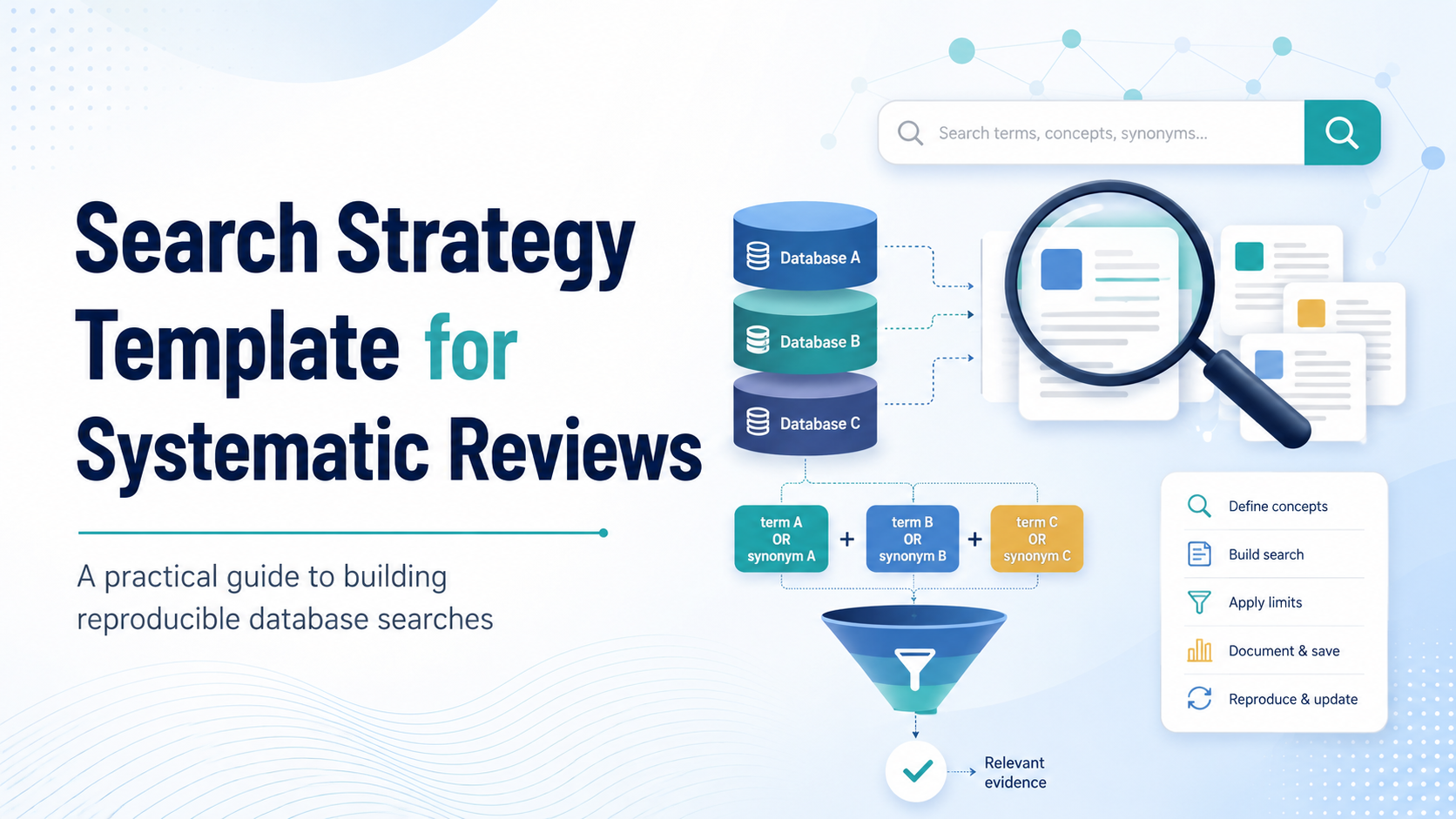
A well-structured search strategy is the backbone of any systematic review. For researchers, librarians, and students tackling literature syntheses, following best practices ensures you retrieve all relevant studies. In this guide, we cover how to build an effective search strategy (using PICO/PCC frameworks and Boolean logic), document it for PRISMA transparency, and even optimize the blog post for search engines and local audiences. We cite Cochrane and PRISMA recommendations to keep methods rigorous.
Define Your Question with PICO or PCC
Start by breaking down your review question into core concepts. For clinical reviews, use PICO (Population, Intervention, Comparison, Outcome). For qualitative or non-intervention topics, similar frameworks like PICo (Population, Interest, Context) or PCC (Population, Concept, Context) help. List synonyms and controlled vocabulary (MeSH terms in PubMed or Emtree in Embase) for each element. For example, if studying exercise vs. medication for chronic pain, Population=“adults with chronic pain”, Intervention=“exercise therapy”, Comparison=“medication”, Outcome=“pain reduction”.
“Each element of PICO should be translated into both controlled vocabulary terms and free-text keywords, then combined with OR within each concept”.
Choose Databases and Sources Carefully
No single database captures all studies. The Cochrane Handbook advises searching multiple sources for high sensitivity. At minimum, include PubMed/MEDLINE and Embase; Cochrane reviews often use 3–5 databases. Also search specialized registers (e.g. CENTRAL, ClinicalTrials.gov) and grey literature (conference proceedings, dissertations). For US-focused topics, include U.S. databases (e.g. PsycINFO, CINAHL). UK researchers might add the Cochrane Library and NHS Evidence, while Indian scholars can use IndMED or Indian journal indexes to catch regional studies.
When writing your blog, mention these locale-appropriate databases (e.g. “In India, the IndMED index supplements PubMed” or “UK librarians often use the British Library’s EThOS repository”). These references signal local relevance. Embedding geo-modifiers (city, country names) in headings or paragraphs can boost local SEO.
Build Your Search String with Boolean Logic
Combine terms using Boolean operators: OR within concept groups, AND between concepts. For example:
(chronic pain OR “pain, chronic”) AND (exercise OR “physical therapy” OR physiotherapy) AND (medication OR drug OR analgesic).
Use both subject headings (e.g. MeSH in MEDLINE, Emtree in Embase) and free-text terms to maximize recall. Don’t use too many concepts – Cochrane warns that adding unrelated blocks can reduce sensitivity. Within each concept, group synonyms with OR for a “wide variety of search terms”.
To ensure rigor, get a second pair of eyes on your strings. The PRESS checklist recommends peer-review by an information specialist or librarian. Indeed, systematic reviews should involve librarians from protocol design onwards. Include this point: “search strategy was developed and validated by an information specialist” to increase credibility.
Understand Search Syntax Across Different Academic Databases
A strong systematic review search strategy should be adapted to each database, because search syntax is not fully interchangeable across platforms. Most academic databases support Boolean operators such as AND, OR, and NOT, but they differ in field tags, proximity operators, phrase searching, truncation, and controlled vocabulary.
For example, PubMed/MEDLINE uses field tags such as [tiab] for title/abstract, [mh] for MeSH terms, and [pt] for publication type. A PubMed search might look like: ("digital health"[tiab] OR telemedicine[tiab]) AND "Diabetes Mellitus"[mh]. PubMed also supports truncation with an asterisk, such as intervention*, and proximity searching in selected fields, such as "patient physician relationship"[Title/Abstract:~0].
Embase is often used alongside PubMed because it includes strong biomedical and pharmacological coverage. Its searches typically combine Emtree terms with free-text terms, for example: 'diabetes mellitus'/exp OR diabet*:ti,ab. In Ovid-based databases, proximity operators such as adj3 are common, meaning two terms appear within three words of each other.
Scopus uses field codes such as TITLE-ABS-KEY() to search titles, abstracts, and keywords. It supports Boolean operators, phrase searching with quotation marks, and proximity operators such as W/n for unordered proximity and PRE/n for ordered proximity. For example: TITLE-ABS-KEY(("machine learning" OR AI) W/3 diagnosis).
Web of Science commonly uses field tags such as TS= for topic searches, TI= for title, and AB= for abstract. A typical search might be: TS=("systematic review" AND "search strategy"). It also supports proximity searching with operators such as NEAR/x, which can help retrieve phrases where words appear close together but not necessarily as an exact phrase.
Cochrane Library is especially useful for clinical trials and evidence synthesis. It supports MeSH-based searching, Boolean logic, and line-by-line search building in Search Manager. For example, a search may combine a MeSH descriptor line with a keyword line, then merge them using OR or AND.
Google Scholar is less precise for systematic review searches because it offers limited advanced syntax and weaker reproducibility. It can still be useful for citation chasing, grey literature discovery, and identifying highly cited papers, but it should not usually replace structured searches in databases such as PubMed, Embase, Scopus, Web of Science, or Cochrane Library.
Because each database has its own rules, reviewers should translate—not copy—the search strategy across platforms. Always record the exact search string, database name, platform or interface, search date, and number of records retrieved. This makes the systematic review search transparent, reproducible, and easier to report in PRISMA.
Refine, Filter, and Document
Apply filters judiciously. Only use date or language limits if justified (e.g. “new drugs not available before 2000”). Avoid arbitrary date cuts, as they introduce bias. Use validated filters for study design (e.g. RCT filters in MEDLINE) to improve precision, but remember CENTRAL and many registers already restrict by study type.
Document every step for transparency. Record the full search strings, databases searched, interface/platform used, and date executed. For PRISMA 2020 compliance, report the number of records retrieved per source. Draft a PRISMA flow diagram or table of results. These details not only fulfill guidelines but also help others reproduce your work.