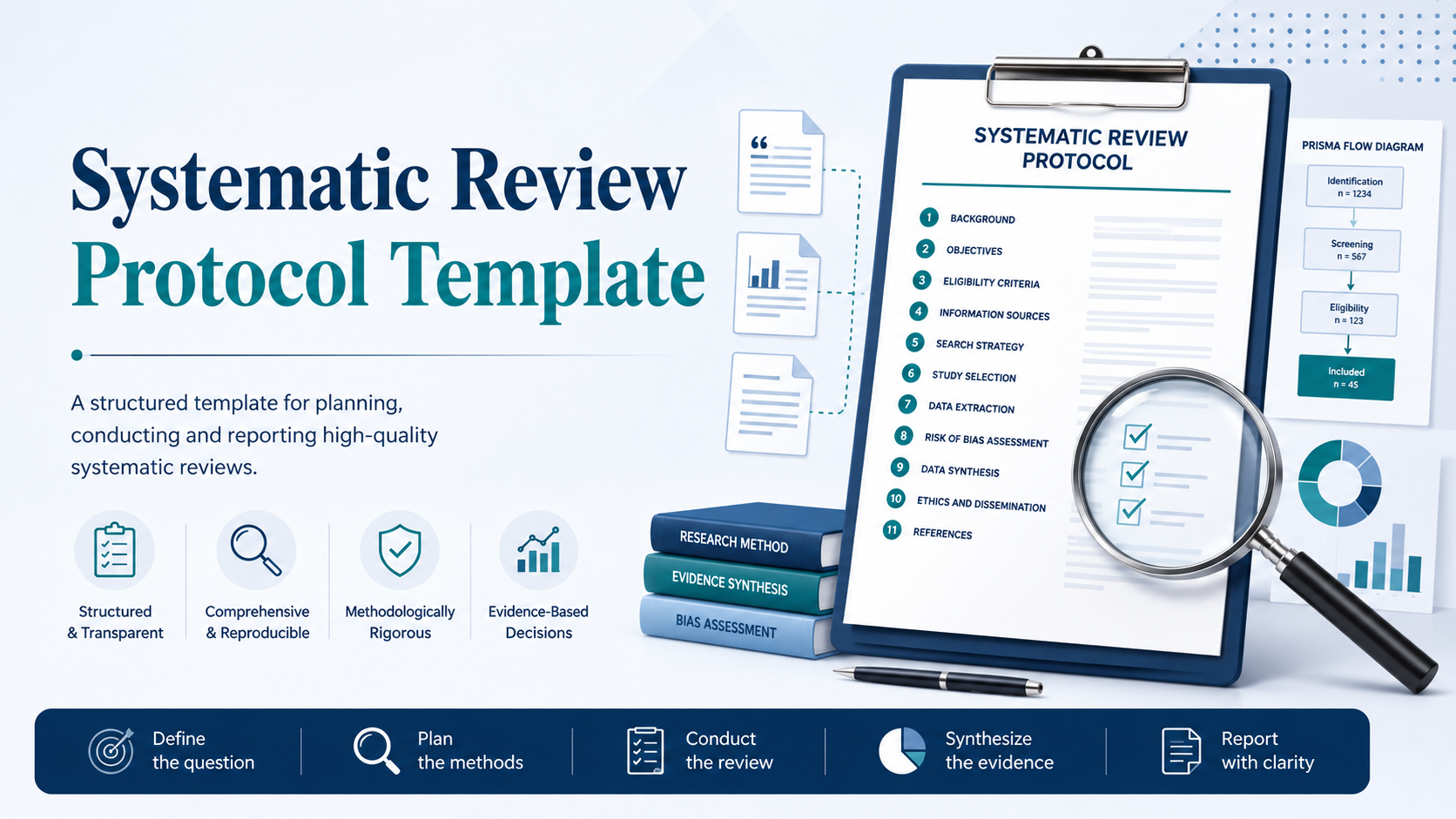
A systematic review protocol is the prospective blueprint for a review. It defines the research question, eligibility criteria, search methods, study-selection procedures, data items, risk-of-bias methods, synthesis strategy, and planned analyses before the review findings are known. A sufficiently detailed protocol makes methodological decisions auditable, helps prevent selective changes based on emerging results, and allows readers to distinguish prespecified methods from later amendments. PRISMA-P was created specifically to improve the completeness and transparency of systematic review and meta-analysis protocols; its checklist contains 17 minimum reporting items.
This blog post provides a complete, copy-paste-ready protocol template based primarily on PRISMA-P, the Cochrane Handbook for Systematic Reviews of Interventions, PROSPERO guidance, PRISMA-S, PRESS, SWiM, and GRADE. The template includes suggested wording, practical guidance, recommended word-count ranges, example PubMed and Embase strategies, a study-selection flowchart, an estimated project timeline, and a final completeness checklist.
The recommended word counts below are editorial planning estimates rather than universal requirements. Journal instructions should always take precedence. As a useful benchmark, Cochrane currently sets a 6,000-word limit for the main text of an intervention-review protocol, excluding items such as references, tables, figures, search strategies, and supplementary materials.
| Protocol component | Suggested length |
|---|---|
| Title and administrative information | 50–150 words |
| Abstract | 250–350 words |
| Background and rationale | 600–900 words |
| Objectives | 100–200 words |
| Eligibility criteria | 400–650 words |
| Information sources and search methods | 400–700 words |
| Study selection and data collection | 400–650 words |
| Risk of bias | 250–400 words |
| Synthesis and meta-analysis | 700–1,100 words |
| Additional analyses and heterogeneity | 300–500 words |
| Certainty of evidence | 150–300 words |
| Ethics, dissemination, timeline, and declarations | 300–500 words |
| Approximate main-text total | 3,900–6,350 words |
Why a Protocol Matters
A protocol should be completed before review results influence methodological decisions. Its central function is not merely to describe a topic, but to establish an operational decision framework: which studies will be eligible, where they will be sought, how reports will be screened, which outcomes and time points will be prioritized, how bias will be assessed, and under what conditions results will be combined. Cochrane describes a protocol as a public record of the intended question and methods and recommends writing protocol methods in the future tense.
PRISMA-P is principally a reporting guideline. It tells authors what information a protocol should report, but it does not by itself guarantee that every planned method is appropriate. The Cochrane Handbook supplies more detailed guidance on conduct, including searching, study selection, data collection, risk-of-bias assessment, meta-analysis, non-meta-analytic synthesis, missing evidence, and GRADE. Good practice therefore involves using PRISMA-P to check reporting completeness while using an appropriate methodological handbook to design the review.
Where eligible, the review should also be prospectively registered. PROSPERO is an international registry for systematic reviews with health-related outcomes and creates a publicly available record of planned review methods. Because registry scope and acceptance rules can change, authors should check the current PROSPERO eligibility page before submission. Registration should complement, rather than replace, a detailed protocol.
The protocol should contain a dated amendment policy. Not every deviation is misconduct: new evidence, unexpected study designs, unavailable data, or statistical problems may require justified changes. However, each substantive change should be recorded with its date, rationale, and stage of the review, and the completed review should distinguish prespecified analyses from post hoc decisions. Cochrane specifically recommends explaining differences between the protocol and the completed review.
Copy-Paste Systematic Review Protocol Template
Replace all text in square brackets with review-specific information. Retain only the guidance that is relevant to the design of the review.
Title
Recommended length: 15–25 words.
The title should identify the document as a protocol and describe the principal population, intervention or exposure, comparator where useful, outcome domain, and review type. PRISMA-P recommends identifying the report as a systematic review protocol and stating whether a meta-analysis is planned.
Template
[Intervention or exposure] for [population or condition]: a protocol for a systematic review and [meta-analysis, if applicable]
Example
Telehealth-delivered cognitive behavioral therapy for adults with depression: a protocol for a systematic review and meta-analysis
Authors and affiliations
Recommended length: 50–120 words, excluding the detailed contribution statement.
List every author’s full name, institutional affiliation, city, country, and persistent researcher identifier where available. Identify the corresponding author and provide a review-team contribution statement. The team should collectively include subject expertise, systematic-review expertise, information-retrieval expertise, and statistical expertise appropriate to the proposed synthesis. Cochrane strongly recommends involving an experienced librarian or information specialist from the protocol stage.
Template
Authors: [Full name], [qualifications]; [Full name], [qualifications]; [Full name], [qualifications]
Affiliations: [Department, institution, city, country]
Corresponding author: [Name and professional email address]
Author contributions: [Author initials] conceived the review. [Initials] developed the eligibility criteria. [Initials] designed the search strategy. [Initials] developed the statistical analysis plan. All authors contributed to the protocol, approved the final version, and accept responsibility for the work.
Abstract
Recommended length: 250–350 words.
Use a structured abstract with the headings Background, Objectives, Methods, Ethics and Dissemination, and Registration. State the review question, eligible study designs, principal information sources, planned risk-of-bias tool, synthesis approach, and registration number or registration status. The abstract must remain consistent with the main protocol. PRISMA-P includes a structured summary among its minimum protocol items.
Template
Background: [Briefly describe the condition, intervention or exposure, uncertainty in the existing evidence, and why the review is needed.]
Objectives: [State the primary objective in one sentence and, where appropriate, the principal secondary objectives.]
Methods: We will include [eligible study designs] examining [population], [intervention or exposure], and [comparator]. We will search [databases and other sources] from [start date or inception] to [anticipated final search date]. Two reviewers will independently [screen records/examine full texts/extract data/assess risk of bias]. Risk of bias will be assessed using [tool]. Where studies are sufficiently comparable, we will conduct [fixed-effect/random-effects] meta-analysis using [effect measures]. Otherwise, findings will be synthesized using [specified alternative synthesis method]. Statistical heterogeneity will be assessed using [methods], and certainty of evidence will be evaluated using GRADE.
Ethics and dissemination: [State whether new ethical approval is required and describe dissemination plans.]
Registration: [PROSPERO registration number, other registry identifier, or “registration pending.”]
Background and rationale
Recommended length: 600–900 words.
The background should progress from the broad problem to the precise evidence gap. Explain the condition or policy issue, the intervention or exposure, its proposed mechanism, the relevant alternatives, the outcomes that matter to patients or decision-makers, and the limitations of existing reviews. Do not justify a new review merely by stating that studies exist. Cochrane recommends explaining the uncertainty, conflict, emerging intervention, implementation problem, or methodological limitation that makes a new synthesis necessary.
The rationale should also establish whether the review is new, an update, or a replication. Search PROSPERO and relevant bibliographic databases for ongoing and completed reviews. If a closely related review exists, specify how the proposed review differs in population, intervention, comparator, outcomes, study design, date range, methods, or intended use.
Template
Description of the condition or problem
[Describe the prevalence, burden, natural history, consequences, and populations affected. Define important terminology and explain variation in diagnosis or classification.]
Description of the intervention or exposure
[Describe what the intervention or exposure is, how it is delivered or measured, its components, intensity, duration, and relevant alternatives.]
How the intervention may work
[Present the biological, behavioral, organizational, social, or policy mechanism through which the intervention could affect the outcomes.]
Existing evidence and uncertainty
[Summarize important primary studies and previous reviews without attempting a full narrative review. Explain inconsistencies, outdated searches, narrow eligibility criteria, methodological weaknesses, or missing outcomes.]
Why this review is needed
[State how the review will address the identified uncertainty and who will use the findings.]
Objectives and review questions
Recommended length: 100–200 words.
The primary objective should be precise enough to determine eligibility and analysis. For intervention reviews, organize the question using population, intervention, comparator, outcomes, and study design. For etiological, diagnostic, prognostic, qualitative, or prevalence reviews, use a framework suited to that question. Cochrane recommends a concise primary objective and permits secondary objectives addressing specific populations, comparisons, outcomes, economic evidence, or qualitative evidence.
Template
The primary objective of this review is to determine the effect of [intervention], compared with [comparator], on [primary outcome or outcome domains] among [population] in [setting, if relevant].
Secondary objectives are to:evaluate effects on [secondary outcomes];examine whether effects vary according to [prespecified effect modifiers];assess the frequency and severity of [adverse outcomes]; andevaluate the certainty of evidence for each critical outcome.
Filled example paragraph
The primary objective of this review is to determine the effects of telehealth-delivered cognitive behavioral therapy, compared with face-to-face psychological therapy, usual care, wait-list control, or attention control, on depressive symptoms in adults with a depressive disorder. Secondary objectives are to evaluate effects on remission, treatment response, quality of life, anxiety symptoms, treatment discontinuation, and adverse events, and to examine whether effects differ according to delivery mode, therapist involvement, baseline depression severity, and duration of follow-up.
Eligibility criteria
Recommended length: 400–650 words.
Eligibility criteria should be operational rather than aspirational. Define how reviewers will handle mixed populations, multi-component interventions, multiple publications, nonstandard outcome measures, conference abstracts, unpublished studies, languages, dates, and overlapping samples. Studies should not be excluded merely because eligible outcomes are not reported in a form suitable for meta-analysis; doing so can introduce selective-reporting bias.
Template
Population
We will include studies involving [population definition], diagnosed or identified using [accepted diagnostic criteria, validated instruments, clinical criteria, administrative definitions, or author definitions]. We will include mixed populations only when [at least X% meet the criteria or separate data can be obtained]. We will exclude [specific populations and rationale].
Intervention or exposure
Eligible interventions or exposures will include [operational definition, components, dose, frequency, duration, delivery mode, and acceptable variants]. We will exclude [ineligible interventions or exposures].
Comparators
Eligible comparators will include [placebo, usual care, no intervention, wait list, active treatment, alternative exposure level, or other specified comparator].
Outcomes
The primary outcome will be [outcome], measured using [preferred or eligible instruments], at [primary time point or hierarchy of time points]. Secondary outcomes will include [list]. Outcomes will not be used as a criterion for excluding an otherwise eligible study unless [clear justification].
Study designs
We will include [randomized controlled trials, cluster-randomized trials, cohort studies, case-control studies, diagnostic-accuracy studies, qualitative studies, or other designs]. We will exclude [designs], because [rationale].
Setting
Studies conducted in [eligible clinical, community, educational, occupational, or geographical settings] will be included.
Publication characteristics
We will include [journal articles, preprints, dissertations, conference abstracts, registry results, regulatory reports, or unpublished data]. We will impose [no language restrictions/the following justified language restrictions]. The search will cover [database inception or date] through [date]. Where translation is required, we will use [professional translation, multilingual team members, or another method].
Multiple reports and overlapping samples
Multiple reports from the same underlying study will be linked and treated as a single study. When reports contain overlapping samples, we will use [the most complete report, the longest follow-up, or a prespecified hierarchy] while retaining supplementary reports as additional data sources.
Information sources
Recommended length: 200–350 words.
List every bibliographic database, platform, trial registry, regulatory source, gray-literature source, website, citation-searching method, and expert-contact procedure. Include the planned coverage dates and the date on which the final search will be rerun. For health-intervention reviews, Cochrane recommends broad searching across relevant databases and trial registries rather than relying on MEDLINE alone. CENTRAL, MEDLINE, and, where accessible, Embase are central sources for randomized trials; topic-specific and regional databases should be added where relevant.
Template
We will search the following bibliographic databases from inception to [date]: [MEDLINE via PubMed or Ovid], [Embase via Ovid or Embase.com], [CENTRAL], [CINAHL], [APA PsycInfo], [Web of Science], [Scopus], and [subject-specific or regional databases].
We will search the following trial registries and results repositories: [ClinicalTrials.gov], [WHO International Clinical Trials Registry Platform], [EU Clinical Trials Register or Clinical Trials Information System], and [other relevant registries].
Gray literature will be sought through [ProQuest Dissertations and Theses, conference proceedings, institutional repositories, government sources, regulatory documents, preprint servers, or other sources].
We will examine the reference lists of included studies and relevant reviews and conduct forward citation searching using [citation index]. We will contact [study authors, experts, professional organizations, or manufacturers] when necessary to identify unpublished studies or obtain missing information.
The searches will be rerun before final analysis or publication. The date of every search and the number of records retrieved from each source will be recorded.
Search strategy
Recommended length: 200–350 words in the main protocol, with complete strategies in an appendix.
Describe who developed the strategy, which concepts were searched, how controlled vocabulary and free-text terms were combined, whether validated design filters were used, and whether restrictions were applied. Cochrane recommends combining database subject headings such as MeSH or Emtree with free-text terms and designing searches for high sensitivity. The complete reproducible strategy should be supplied for at least one database and adapted, rather than mechanically copied, for the syntax of every other platform.
PRISMA-S provides a 16-item framework for transparent search reporting, while PRESS provides a structured method for peer review of electronic search strategies. Peer review should examine the translation of the review question, Boolean and proximity operators, subject headings, free-text terms, spelling, syntax, and limits.
Template
The search strategy will be developed by [name or role], in consultation with [information specialist or librarian]. It will combine controlled vocabulary and free-text terms for [principal concepts]. Search terms will be informed by [sentinel studies, existing reviews, thesaurus exploration, text mining, or expert consultation].
A validated study-design filter will be used where appropriate. No language, publication-status, or date restrictions will be applied unless explicitly justified. The draft strategy will be peer reviewed using the PRESS checklist by an information specialist who was not responsible for the original strategy.
The complete strategy for [database and platform] is presented in [Appendix number]. Strategies for other databases will be translated to platform-specific subject headings, field codes, proximity operators, truncation rules, and syntax. All searches will be documented with the database name, platform, coverage dates, search date, complete strategy, and number of records retrieved.
Filled example paragraph
An information specialist will develop the search in consultation with the clinical and methodological members of the review team. The strategy will combine MeSH, Emtree, and free-text terms representing depressive disorders, cognitive behavioral therapy, and telehealth delivery. A sensitive randomized-trial concept will be added for databases that are not already restricted to controlled trials. No language or publication-status restrictions will be applied. The PubMed strategy will be peer reviewed by a second information specialist using the PRESS checklist and then translated for Embase, CENTRAL, APA PsycInfo, and CINAHL. Search dates, exact strategies, and the number of records retrieved from each source will be retained in an electronic search log.
Study selection
Recommended length: 200–350 words.
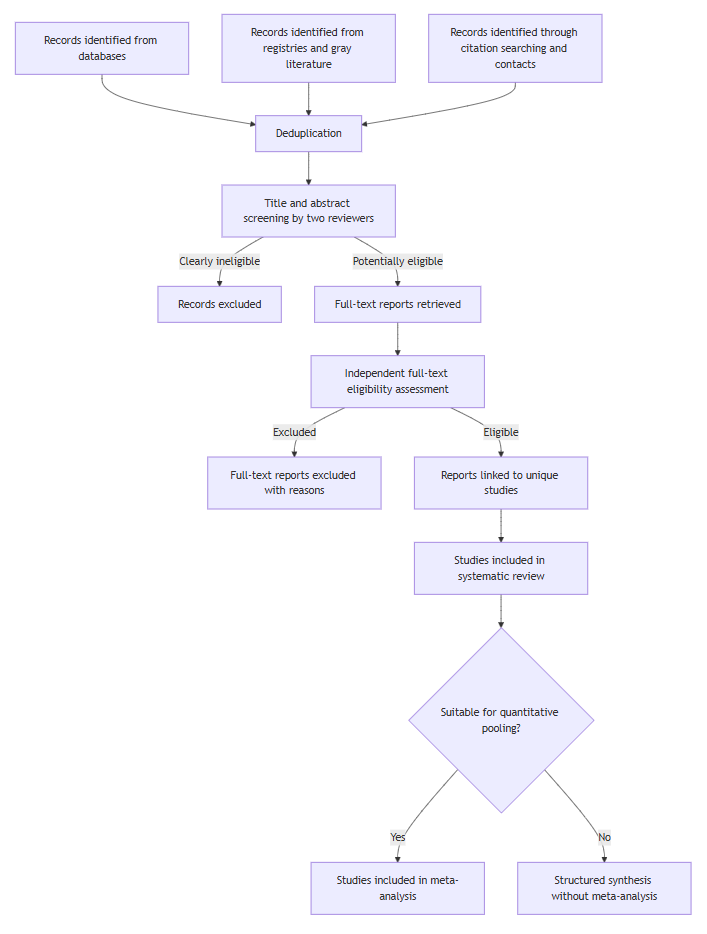
State how records will be deduplicated, piloted, screened, retrieved, linked into studies, and excluded. At least two reviewers should independently make final full-text eligibility decisions, with a predefined disagreement procedure. Duplicate publications must be linked because the unit of inclusion is the study, not the individual report.
Template
Search results will be imported into [reference-management software] and deduplicated using [automated and manual procedures]. Before formal screening, reviewers will pilot the eligibility criteria on [number] records and refine the guidance without changing the substantive scope of the review.
Two reviewers will independently screen titles and abstracts. Records considered potentially eligible by either reviewer will undergo full-text assessment. Two reviewers will then independently assess each full-text report against the eligibility criteria and record one primary reason for exclusion.
Disagreements will be resolved through discussion and, when necessary, adjudication by a third reviewer. Reviewers will not be required to remain blinded to study authors, institutions, journals, or results.
Multiple reports of the same study will be linked under a single study identifier. The selection process will be documented in a PRISMA flow diagram, and excluded full-text reports will be listed with reasons for exclusion.
Data extraction and data management
Recommended length: 250–400 words.
Specify the extraction form, pilot process, number of reviewers, reconciliation method, data storage, and procedures for obtaining missing data. Data collection should cover study methods, participants, settings, interventions, comparators, outcomes, numerical results, funding, conflicts of interest, and information needed for risk-of-bias assessment. Cochrane recommends designing structured forms in advance and preserving data in a form suitable for checking, sharing, and future updates.
Template
A standardized data-extraction form will be developed in [software] and piloted on [number] included studies. Two reviewers will independently extract data, or one reviewer will extract and a second will verify all fields. Disagreements will be resolved by consensus or third-reviewer adjudication.
We will extract:bibliographic and study-identification information;study design, setting, country, recruitment period, and follow-up;participant eligibility criteria and baseline characteristics;intervention and comparator components, dose, intensity, duration, delivery mode, adherence, and co-interventions;outcome definitions, measurement instruments, time points, and analysis populations;numerical data required to calculate effect estimates and measures of precision;withdrawals, missing data, and reasons for attrition;study registration, protocol availability, funding, and author conflicts of interest; andinformation required for risk-of-bias judgments.
When multiple eligible measures or time points are available, we will apply the following prespecified hierarchy: [insert hierarchy]. We will contact study authors for missing or unclear information using [number] contact attempts over [time period]. Extracted data, decisions, and correspondence will be maintained in [secure repository or software], with an auditable record of corrections.
Risk of bias assessment
Recommended length: 250–400 words.
Select a tool appropriate to the study design and the result being evaluated. For randomized trials, Cochrane recommends RoB 2, which assesses bias arising from the randomization process, deviations from intended interventions, missing outcome data, outcome measurement, and selection of the reported result. Risk-of-bias judgments should be supported by explicit reasons and source information.
Template
Two reviewers will independently assess risk of bias using [tool and version]. For randomized trials, we will use [RoB 2]; for non-randomized studies, we will use [design-appropriate tool]. Assessments will be made for [specified outcomes, results, and time points], rather than only at an undifferentiated study level.
Reviewers will complete the tool’s signaling questions and assign domain-level and overall judgments according to its published algorithm. Each judgment will be accompanied by supporting text or a description of the relevant source. Disagreements will be resolved by consensus or third-reviewer adjudication.
Risk-of-bias assessments will be presented in tables and visual summaries and will inform the synthesis, sensitivity analyses, GRADE judgments, and interpretation of findings. Studies will not be automatically assigned numerical quality scores.
Data synthesis
Recommended length: 300–500 words.
The protocol should define how studies will be grouped, which results will be prioritized, how study characteristics and findings will be tabulated, and what will happen when meta-analysis is inappropriate. A vague promise to conduct a “narrative synthesis” is insufficient. Cochrane recommends planning transparent alternative synthesis methods and warns against vote counting based only on whether individual results are statistically significant.
Template
Studies will first be grouped by [population], [intervention or exposure], [comparator], [outcome domain], [time point], and [study design]. We will present study characteristics, risk-of-bias judgments, and outcome data in structured tables.
Meta-analysis will be undertaken only when studies are sufficiently comparable in clinical question, design, intervention or exposure definition, comparator, outcome construct, and effect measure. Decisions to combine studies will not be based solely on the result of a statistical heterogeneity test.
When meta-analysis is not appropriate, we will use [specified synthesis method], such as structured tabulation, synthesis of standardized effect estimates without pooling, or another design-appropriate approach. We will state how studies are grouped, how metrics are standardized, how results are prioritized, how patterns are evaluated, and how limitations of the synthesis affect interpretation. Reporting will follow SWiM where applicable.
Filled example paragraph
Studies will be grouped according to comparator type—active psychological treatment, usual care, wait-list control, or attention control—and according to follow-up period: post-treatment, short term up to six months, and long term beyond six months. We will summarize participant characteristics, telehealth modality, therapist involvement, treatment intensity, outcome instruments, and risk-of-bias judgments in structured tables. Where pooling is not clinically or statistically defensible, we will present study-level effect estimates with confidence intervals in forest plots without a pooled diamond and provide a structured synthesis organized by comparator and follow-up. We will not classify an intervention as effective merely by counting the number of studies with statistically significant results.
Meta-analysis plans
Recommended length: 350–600 words.
Predefine effect measures, model, estimator, confidence intervals, handling of multi-arm and cluster trials, outcome hierarchies, missing summary statistics, and software. The fixed-effect versus random-effects choice should follow the review question and assumptions about underlying effects; Cochrane explicitly advises against selecting the model solely from a heterogeneity test.
Template
For dichotomous outcomes, we will calculate [risk ratios, odds ratios, or risk differences] with 95% confidence intervals. For continuous outcomes measured on the same scale, we will calculate mean differences; when different validated scales measure the same construct, we will calculate standardized mean differences. For time-to-event outcomes, we will use hazard ratios where available.
The primary meta-analysis will use a [fixed-effect/random-effects] model because [state the conceptual rationale]. Between-study variance will be estimated using [method, such as restricted maximum likelihood], and confidence intervals will be calculated using [method]. Where appropriate and supported by a reasonable number of studies, we will report a prediction interval to describe the distribution of underlying effects.
Multi-arm studies will be handled by [combining relevant arms, splitting a shared comparator, or using a multivariate method] to avoid double counting. Cluster-randomized trials will be included only after accounting for clustering. Crossover trials will be analyzed using [paired methods or another specified approach].
When required statistics are not reported, we will calculate or derive them from confidence intervals, standard errors, test statistics, or other available data using established formulas. Any imputation assumptions will be documented and examined in sensitivity analyses. Study authors will be contacted before substantial imputations are made.
The primary analysis will use [intention-to-treat, adjusted, or other estimates] according to the following hierarchy: [insert hierarchy]. Meta-analysis will be conducted using [software and version or planned software environment].
Filled example paragraph
For depressive-symptom severity, we will calculate standardized mean differences with 95% confidence intervals because eligible trials are expected to use different validated scales. For remission and treatment discontinuation, we will calculate risk ratios. We will use a random-effects model with restricted maximum likelihood estimation because intervention effects may vary across delivery platforms, levels of therapist support, and clinical settings. Where at least five reasonably comparable studies contribute to an analysis and no clear small-study asymmetry is present, we will also calculate a 95% prediction interval. The primary analysis will use post-intervention data and intention-to-treat estimates. Shared comparator groups in multi-arm trials will be divided across relevant pairwise comparisons unless a model that accounts for their correlation is used.
Cochrane notes that prediction intervals can help communicate between-study variability but can be unstable with very few studies; it encourages their use when the number of studies is reasonable, giving five or more as an illustrative threshold.
Assessment of heterogeneity
Recommended length: 150–250 words.
Heterogeneity should be evaluated conceptually and statistically. Clinical heterogeneity may arise from populations, settings, interventions, comparators, outcomes, or follow-up; methodological heterogeneity may arise from study design or risk of bias. Statistical assessment commonly includes visual inspection of forest plots, the chi-squared test, I², and the between-study variance, but none should be interpreted in isolation. Prediction intervals may be useful in suitable random-effects analyses.
Template
We will assess clinical heterogeneity by comparing populations, settings, intervention or exposure characteristics, comparators, outcome definitions, and follow-up periods. Methodological heterogeneity will be evaluated through study design, analysis methods, and risk-of-bias patterns.
Statistical heterogeneity will be examined using forest plots, the chi-squared test, I², and the estimated between-study variance. These statistics will be interpreted in the context of the number and size of studies, the direction and magnitude of effects, confidence-interval overlap, and clinically plausible sources of variation.
If heterogeneity makes an average effect difficult to interpret, we will reconsider whether pooling is appropriate, present prediction intervals where suitable, investigate prespecified effect modifiers, and provide a cautious structured synthesis.
Subgroup and sensitivity analyses
Recommended length: 200–350 words.
Subgroup hypotheses should be few, clinically plausible, and prespecified. Formal interaction tests should be used when comparing subgroups; a statistically significant result in one subgroup and a nonsignificant result in another does not itself demonstrate a subgroup difference. Meta-regression generally requires a substantial number of studies, with approximately ten studies per modeled characteristic often used as a minimum planning rule.
Template
Subject to sufficient data, we will conduct subgroup analyses according to:[population characteristic and rationale];[intervention or exposure characteristic and rationale];[comparator characteristic and rationale];[setting or follow-up characteristic and rationale]; and[study-design characteristic and rationale].
Differences between subgroups will be evaluated using formal interaction tests. Subgroup findings will be interpreted cautiously because they are observational comparisons and may be confounded by other study-level characteristics.
We will assess the robustness of primary findings through sensitivity analyses that:exclude studies at high risk of bias;use alternative eligible effect measures or statistical models;exclude imputed data;alter assumptions about missing outcomes;exclude unpublished or non-peer-reviewed reports, where relevant;account for cluster or multi-arm designs using alternative reasonable methods; andremove influential outliers only when the rationale is defined independently of their effect direction.
Analyses not specified in this protocol will be labeled exploratory or post hoc.
Assessment of publication bias and missing evidence
Recommended length: 150–250 words.
A protocol should address more than conventional “publication bias.” Missing evidence can arise when entire studies are unavailable or when particular outcomes and analyses are selectively omitted. Funnel-plot asymmetry can reflect publication bias, but it can also arise from heterogeneity, methodological differences, chance, or other small-study effects. Cochrane recommends using formal asymmetry tests only when at least ten studies are included in a meta-analysis and interpreting them alongside visual and substantive evidence.
Template
We will minimize missing-evidence bias by searching trial registries, gray literature, reference lists, and relevant regulatory or results repositories and by contacting investigators for unreported outcomes or numerical results.
For each critical outcome, we will compare available publications, trial registrations, protocols, and statistical analysis plans where accessible. We will document eligible studies that do not contribute data to a synthesis and investigate whether non-contribution may be related to the nature of the results.
When at least ten suitably diverse studies contribute to a meta-analysis, we will examine contour-enhanced funnel plots and conduct an effect-measure-appropriate test for asymmetry. Asymmetry will not be treated as diagnostic of publication bias; alternative explanations will be considered.
Confidence in cumulative evidence using GRADE
Recommended length: 150–300 words.
GRADE evaluates certainty separately for each important outcome using four categories: high, moderate, low, and very low. The five principal domains for possible downgrading are risk of bias, inconsistency, indirectness, imprecision, and publication bias. Judgments and reasons should be transparent, ideally made independently by two reviewers.
Template
Two reviewers will independently assess the certainty of evidence for each critical and important outcome using GRADE. We will evaluate risk of bias, inconsistency, indirectness, imprecision, and publication bias and will consider upgrading criteria where appropriate to the evidence base.
Certainty will be classified as high, moderate, low, or very low. All downgrading and upgrading decisions will be justified in footnotes. Disagreements will be resolved through discussion or third-reviewer adjudication.
We will prepare a Summary of Findings table for the principal comparison, presenting the number of studies and participants, relative and absolute effects where applicable, and the certainty of evidence for each prioritized outcome.
Ethics
Recommended length: 75–150 words.
Avoid making a universal claim that systematic reviews never require ethics approval. Instead, state whether the review will use only publicly available aggregate information, whether individual participant data will be obtained, and which institutional rules apply.
Template
This review will synthesize data from [publicly available reports/aggregate data supplied by investigators/individual participant data]. [Institutional ethics approval is not required under the applicable policy because no new participant-level data will be collected / Ethical approval has been obtained from …, reference …]. Any confidential or individual participant data will be stored, processed, and reported in accordance with the relevant data-use agreements and institutional requirements.
Dissemination
Recommended length: 100–180 words.
Template
The completed review will be submitted to a peer-reviewed journal and presented at relevant scientific or professional meetings. Findings will also be disseminated through [plain-language summaries, policy briefs, patient organizations, professional associations, institutional repositories, teaching materials, or public engagement].
Where permitted, the final search strategies, screening decisions, extraction form, analytic data, statistical code, risk-of-bias judgments, GRADE evidence profiles, and amendment history will be deposited in [repository]. Authorship and acknowledgment will follow the policies of the target journal and participating institutions.
Timeline
Recommended length: 75–150 words in the protocol, supported by a table.
Template
The review is expected to begin in [month and year] and conclude in [month and year]. The anticipated dates for protocol completion, searching, screening, data extraction, risk-of-bias assessment, synthesis, GRADE assessment, and manuscript submission are provided in the project timeline. Delays or substantive changes will be documented in the amendment log and registry record.
Funding and support
Recommended length: 50–100 words.
State monetary and nonmonetary support and describe the funder’s role. PRISMA-P requires disclosure of funding sources and the role of sponsors or funders.
Template
This review is supported by [funder, grant number, institution, or “no specific funding”]. The funder [will have no role / will have the following role] in protocol development, study selection, data extraction, analysis, interpretation, manuscript preparation, or the decision to publish.
Conflicts of interest
Recommended length: 50–120 words.
Template
[Author initials] declare [financial, professional, intellectual, institutional, or other interests relevant to the review]. [Remaining authors] declare no competing interests. Reviewers with a conflict relating to a potentially eligible study will not make final eligibility, risk-of-bias, or data-extraction decisions for that study.
Registration, protocol access, and amendments
Recommended length: 100–180 words.
Template
This review has been registered with [PROSPERO or another registry] under registration number [identifier]. The full protocol is available from [journal, repository, or institutional source].
Important amendments will be recorded in a dated amendment table containing: the original method, the revised method, the reason for the change, the review stage at which the change occurred, and whether the decision was made before or after relevant results were examined. The registry record will be updated where possible, and the completed review will report all substantive differences from this protocol.
Search Strategy Examples
The following strings illustrate a review of telehealth-delivered cognitive behavioral therapy for adults with depression. They are examples, not validated universal searches. Every strategy should be tested against known relevant studies, reviewed by an information specialist, and adapted to the exact database platform. Database syntax differs: PubMed uses field tags such as [Mesh], [tiab], and [pt], while Ovid Embase uses slash notation for Emtree headings and fields such as .ti,ab,kw..
Example PubMed strategy
(
  "Depressive Disorder"[Mesh]
  OR depress*[tiab]
  OR "major depressive disorder"[tiab]
  OR MDD[tiab]
)
AND
(
  "Cognitive Behavioral Therapy"[Mesh]
  OR CBT[tiab]
  OR (
    (cognitive[tiab] OR cognition[tiab])
    AND
    (behavior*[tiab] OR behaviour*[tiab])
    AND
    therap*[tiab]
  )
)
AND
(
  "Telemedicine"[Mesh]
  OR telehealth[tiab]
  OR telemedicine[tiab]
  OR videoconferenc*[tiab]
  OR internet-delivered[tiab]
  OR internet-based[tiab]
  OR online[tiab]
  OR remote[tiab]
)
AND
(
  randomized controlled trial[pt]
  OR controlled clinical trial[pt]
  OR random*[tiab]
  OR trial[tiab]
)
Before finalizing a PubMed strategy, examine how PubMed’s automatic term mapping treats untagged terms, confirm current MeSH headings, inspect Search Details, and test whether the strategy retrieves a set of known eligible records. PubMed’s official help documentation should be treated as the source of truth for current field tags and search behavior.
Example Ovid Embase strategy
1. exp depression/
2. (depress* or "major depressive disorder" or MDD).ti,ab,kw.
3. 1 or 2

4. exp cognitive therapy/
5. (CBT or ((cognitive or cognition) adj3 (behavior* or behaviour* or therap*))).ti,ab,kw.
6. 4 or 5

7. exp telemedicine/
8. (telehealth or telemedicine or videoconferenc* or internet-delivered
   or internet-based or online or remote).ti,ab,kw.
9. 7 or 8

10. randomized controlled trial/
11. controlled clinical trial/
12. (random* or trial).ti,ab,kw.
13. 10 or 11 or 12

14. 3 and 6 and 9 and 13
15. remove duplicates from 14
The exact Emtree headings, explosion behavior, limits, deduplication commands, and field codes should be verified in the licensed platform. Embase is offered through different interfaces, including Ovid and Embase.com, and a strategy written for one should not be assumed to work unchanged in another. Cochrane recommends translating each strategy with attention to the platform’s controlled vocabulary, text fields, Boolean operators, proximity operators, and syntax.
Search documentation template
| Source | Platform | Coverage searched | Search date | Records retrieved | Strategy location |
|---|---|---|---|---|---|
| MEDLINE | [PubMed/Ovid] | [Inception–date] | [Date] | [n] | Appendix [X] |
| Embase | [Ovid/Embase.com] | [Inception–date] | [Date] | [n] | Appendix [X] |
| CENTRAL | Cochrane Library | [Issue/date] | [Date] | [n] | Appendix [X] |
| Trial registry | [Registry] | [Coverage] | [Date] | [n] | Appendix [X] |
| Gray-literature source | [Platform] | [Coverage] | [Date] | [n] | Appendix [X] |
| Citation search | [Platform] | Not applicable | [Date] | [n] | Search log |
Study Selection Flowchart and Project Timeline
The protocol should describe the planned selection process even though the final numbers are not yet known. The completed review should replace the placeholders below with the actual number of records, reports, and studies and should distinguish records from reports and underlying studies. Cochrane emphasizes that a single study can have several reports and that these reports must be linked to prevent double counting.
The timeline below assumes a moderately sized review conducted by an active team. It is an estimated planning template, not an authoritative duration. Complex searches, multilingual screening, individual participant data, large evidence bases, network meta-analysis, or extensive author correspondence may require substantially more time.
| Phase | Main activities | Estimated period | Target dates |
|---|---|---|---|
| Scoping | Refine question, map prior reviews, confirm feasibility | 1–2 weeks | [Dates] |
| Team formation | Confirm roles, expertise, governance, conflicts | 1 week | [Dates] |
| Protocol drafting | Eligibility, outcomes, methods, analysis plan | 2–4 weeks | [Dates] |
| Search development | Draft, test, peer review, and translate strategies | 2–4 weeks | [Dates] |
| Registration and protocol submission | Submit to registry, repository, or journal | 1–3 weeks | [Dates] |
| Search execution | Run searches, export results, deduplicate | 1 week | [Dates] |
| Title and abstract screening | Pilot criteria and screen records | 2–5 weeks | [Dates] |
| Full-text assessment | Retrieve reports, decide eligibility, record reasons | 2–5 weeks | [Dates] |
| Data extraction | Pilot forms, extract and verify study data | 3–6 weeks | [Dates] |
| Risk-of-bias assessment | Independent assessment and consensus | 2–4 weeks | [Dates] |
| Data synthesis | Prepare tables, calculate effects, conduct analyses | 3–6 weeks | [Dates] |
| Additional analyses | Heterogeneity, subgroups, sensitivity, missing evidence | 1–3 weeks | [Dates] |
| GRADE | Prepare evidence profiles and Summary of Findings table | 1–2 weeks | [Dates] |
| Writing and review | Draft, revise, stakeholder review, final checks | 3–6 weeks | [Dates] |
| Submission and dissemination | Journal submission, repository upload, summaries | 1–2 weeks | [Dates] |
| Estimated total | Several phases may overlap | approximately 5–9 months | [Start–finish] |
Protocol Completeness Checklist
This checklist consolidates the core information expected across PRISMA-P and the principal methodological areas addressed by Cochrane. It should be used alongside, not instead of, the official PRISMA-P checklist.
| Item | Minimum information to report | Complete |
|---|---|---|
| Title | Identifies the document as a systematic review protocol and states whether meta-analysis is planned | ☐ |
| Authors | Names, affiliations, corresponding author, and contributions | ☐ |
| Review expertise | Subject, methods, searching, and statistical expertise represented | ☐ |
| Registration | Registry name, identifier, status, and protocol-access information | ☐ |
| Amendments | Procedure for dating, explaining, and reporting changes | ☐ |
| Abstract | Background, objectives, eligibility, sources, methods, synthesis, GRADE, and registration | ☐ |
| Background | Condition or problem, intervention or exposure, mechanism, and importance | ☐ |
| Rationale | Existing reviews and the specific unresolved evidence gap | ☐ |
| Objectives | Precise primary objective and justified secondary objectives | ☐ |
| Population | Operational inclusion and exclusion criteria | ☐ |
| Intervention or exposure | Components, dose, duration, delivery, and acceptable variants | ☐ |
| Comparator | Eligible comparison conditions or exposure categories | ☐ |
| Outcomes | Primary and secondary outcomes, measures, time points, and hierarchy | ☐ |
| Study designs | Eligible and excluded designs with rationale | ☐ |
| Publication criteria | Date, language, status, and report-type rules | ☐ |
| Information sources | Databases, platforms, registries, gray literature, citation searches, and contacts | ☐ |
| Search strategy | Full reproducible strategy for at least one database | ☐ |
| Search quality | Information-specialist involvement and PRESS peer review | ☐ |
| Search updates | Planned final rerun and search-documentation process | ☐ |
| Deduplication | Software and manual checking procedures | ☐ |
| Title and abstract screening | Number of reviewers, pilot process, and disagreement method | ☐ |
| Full-text selection | Independent decisions, exclusion reasons, and adjudication | ☐ |
| Multiple reports | Procedure for linking reports to unique studies | ☐ |
| Data-extraction form | Fields, piloting, software, and version control | ☐ |
| Extraction process | Independent extraction or verification and consensus procedure | ☐ |
| Missing information | Author-contact and data-imputation procedures | ☐ |
| Risk of bias | Design-appropriate tool, outcomes assessed, reviewers, and judgment rules | ☐ |
| Synthesis groups | Rules for grouping studies by question, comparison, and outcome | ☐ |
| Effect measures | Measures for dichotomous, continuous, and time-to-event outcomes | ☐ |
| Meta-analysis model | Model, estimator, confidence-interval method, and conceptual rationale | ☐ |
| Complex designs | Cluster, crossover, multi-arm, repeated-measure, or dependent-data methods | ☐ |
| No-meta-analysis plan | Explicit alternative synthesis method and presentation approach | ☐ |
| Heterogeneity | Clinical, methodological, and statistical assessment | ☐ |
| Subgroup analyses | Small set of prespecified, justified effect modifiers | ☐ |
| Sensitivity analyses | Decisions and assumptions whose influence will be tested | ☐ |
| Missing-evidence bias | Registries, unpublished results, funnel plots, and asymmetry tests | ☐ |
| Certainty of evidence | GRADE domains, reviewers, outcomes, and Summary of Findings plan | ☐ |
| Ethics | Approval status, data type, confidentiality, and data-use requirements | ☐ |
| Dissemination | Journal, conference, stakeholder, public, and repository plans | ☐ |
| Timeline | Milestones, target dates, and responsible team members | ☐ |
| Funding | Funding source, grant information, and funder’s role | ☐ |
| Conflicts of interest | Relevant financial and nonfinancial interests and management plan | ☐ |
| Data and code | Planned availability of forms, decisions, data, code, and evidence profiles | ☐ |
References
Moher D, Shamseer L, Clarke M, Ghersi D, Liberati A, Petticrew M, Shekelle P, Stewart LA. Preferred Reporting Items for Systematic Review and Meta-Analysis Protocols—PRISMA-P—2015 Statement. The statement and downloadable checklist are maintained by the PRISMA Executive.
Shamseer L, Moher D, Clarke M, Ghersi D, Liberati A, Petticrew M, Shekelle P, Stewart LA, and the PRISMA-P Group. Preferred Reporting Items for Systematic Review and Meta-Analysis Protocols—PRISMA-P—2015: Elaboration and Explanation. This paper explains the rationale and expected content for the 17 PRISMA-P items.
Higgins JPT, Thomas J, Chandler J, Cumpston M, Li T, Page MJ, Welch VA, editors. Cochrane Handbook for Systematic Reviews of Interventions. The Handbook provides detailed methods for planning reviews, searching and selecting studies, collecting data, assessing bias, synthesizing evidence, conducting meta-analysis, assessing missing evidence, and applying GRADE.
Lefebvre C, Glanville J, Briscoe S, et al. Cochrane Handbook Chapter: Searching for and Selecting Studies. This chapter addresses database selection, controlled vocabulary, free-text searching, registries, gray literature, search documentation, duplicate reports, and independent eligibility decisions.
Li T, Higgins JPT, Deeks JJ. Cochrane Handbook Chapter: Collecting Data. This chapter covers data sources, extraction forms, multiple reports, missing information, study characteristics, outcomes, numerical results, and data management.
Boutron I, Page MJ, Higgins JPT, Altman DG, Lundh A, Hróbjartsson A. Cochrane Handbook Chapter: Considering Bias and Conflicts of Interest Among Included Studies. This chapter explains result-level risk-of-bias assessment, transparent judgment, and incorporation of bias into synthesis and interpretation.
Deeks JJ, Higgins JPT, Altman DG, and the Cochrane Statistical Methods Group. Cochrane Handbook Chapter: Analysing Data and Undertaking Meta-Analyses. This chapter addresses effect measures, models, heterogeneity, prediction intervals, subgroup analyses, meta-regression, missing data, and sensitivity analyses.
Page MJ, Higgins JPT, Sterne JAC. Cochrane Handbook Chapter: Assessing Risk of Bias Due to Missing Evidence in a Meta-Analysis. This chapter covers missing studies, missing outcomes, selective non-reporting, funnel plots, asymmetry tests, and the limitations of publication-bias diagnostics.
Schünemann HJ, Higgins JPT, Vist GE, et al. Cochrane Handbook Chapter: Completing Summary of Findings Tables and Grading the Certainty of the Evidence. This chapter describes the four GRADE certainty categories and the five principal domains for downgrading.
University of York Centre for Reviews and Dissemination. PROSPERO: International Prospective Register of Systematic Reviews. The registry provides public records of planned health-related systematic reviews and maintains current registration and eligibility guidance.
Rethlefsen ML, Kirtley S, Waffenschmidt S, et al. PRISMA-S: An Extension to the PRISMA Statement for Reporting Literature Searches in Systematic Reviews. PRISMA-S contains 16 items for transparent reporting of systematic-review searches.
McGowan J, Sampson M, Salzwedel DM, Cogo E, Foerster V, Lefebvre C. PRESS Peer Review of Electronic Search Strategies: 2015 Guideline Statement. PRESS provides a structured framework for reviewing search concepts, headings, keywords, operators, syntax, and limits.
Campbell M, McKenzie JE, Sowden A, et al. Synthesis Without Meta-Analysis—SWiM—in Systematic Reviews: Reporting Guideline. SWiM supports transparent reporting when quantitative findings cannot appropriately be combined through conventional meta-analysis.
GRADE Working Group. GRADE Book. The official GRADE resource provides current guidance on answerable questions, certainty of evidence, evidence-to-decision frameworks, and presentation of findings.