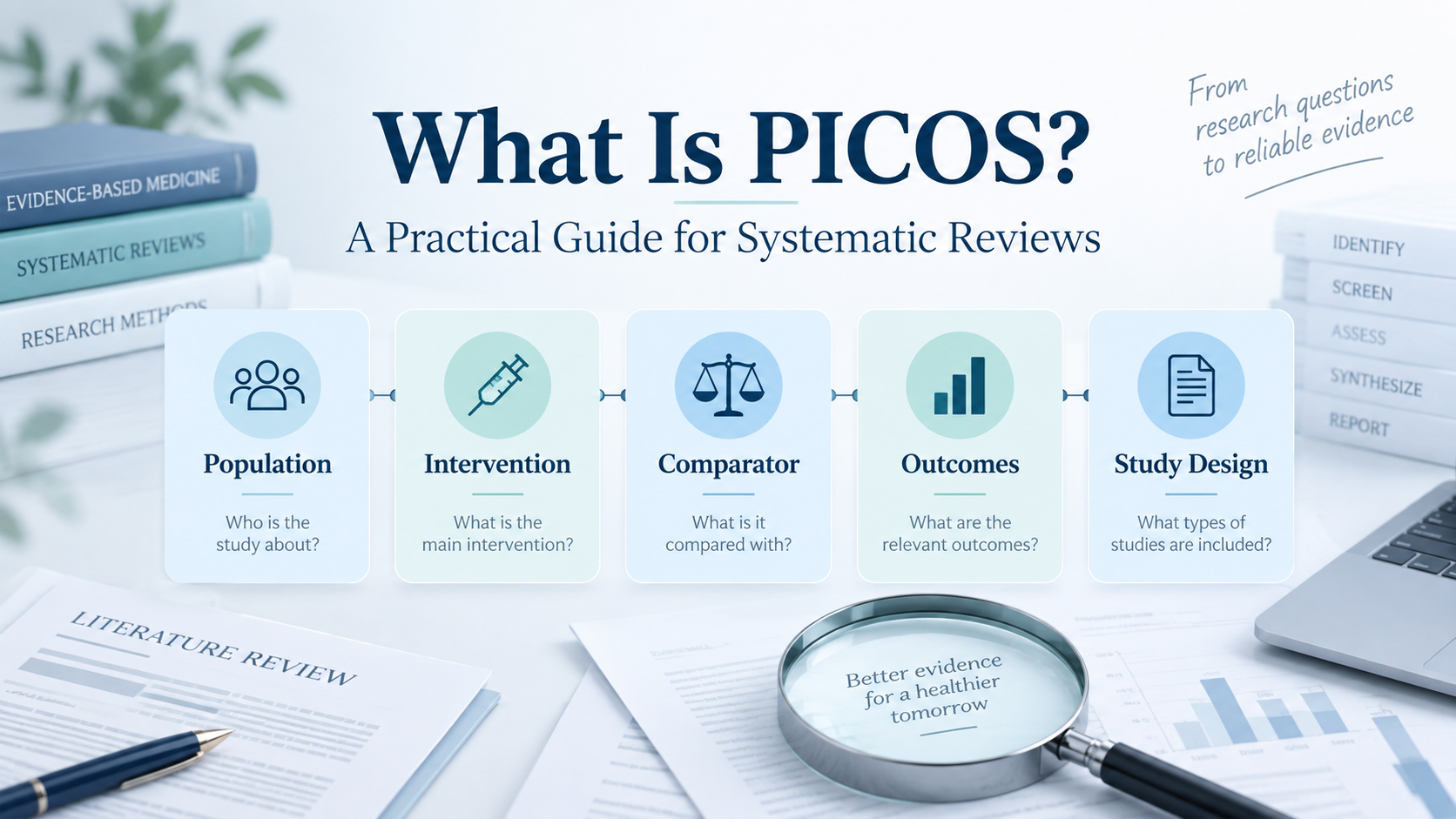
PICOS is a framework for defining a research question and deciding which studies belong in a systematic review. It stands for Population, Intervention, Comparator, Outcomes, and Study design. By making these five elements explicit, researchers can turn a broad topic into a focused question with clear eligibility criteria.
Consider the question: “Does AI improve learning?”
It is a useful starting point, but it leaves important decisions unresolved. Which learners? What kind of AI? Compared with what? How will improvement be measured? Which research designs will provide the evidence?
PICOS helps you make those decisions before you start selecting studies. Its value is not simply that it produces a better-worded question. It gives your review a scope that other researchers can understand, apply, and evaluate.
What Does PICOS Stand For?
The five components of PICOS describe the people, intervention, comparison, outcomes, and study designs relevant to a review. The terminology varies slightly across sources: Population may also appear as Participants, and Comparator as Comparison or Control.
| Element | Meaning | Question to answer |
|---|---|---|
| P — Population | The participants or group of interest | Who is the research about? |
| I — Intervention | The treatment, program, technology, or approach being evaluated | What is being investigated? |
| C — Comparator | The alternative against which the intervention is assessed | What is it being compared with? |
| O — Outcomes | The effects or endpoints the review will examine | What will be measured? |
| S — Study design | The types of studies eligible for inclusion | What research designs will provide the evidence? |
The framework is easiest to understand through a concrete example. Suppose you are planning a review of AI-generated feedback in university writing courses.
P: Define the Population
“Students” is a broad population. For this hypothetical review, a more useful definition might be:
Undergraduate students enrolled in university-level academic writing courses.
This wording raises practical questions. Will postgraduate students be excluded? What about a study with both undergraduate and postgraduate participants? Would it qualify only when the undergraduate results can be examined separately?
A useful population definition anticipates these borderline cases rather than leaving every reviewer to interpret them differently.
I: Define the Intervention
For the intervention, “AI tools” would still be too broad. A more specific definition could be:
AI-generated formative feedback provided on students’ academic writing.
The review team would then need to decide whether this includes automated essay scoring, grammar suggestions, conversational feedback, or only feedback on argument, organization, and content.
The intervention definition should identify the features that make an approach relevant to the question. It should not depend only on the product name or the terminology used by an individual author.
C: Define the Comparator
For this example, the comparator might be:
Instructor-provided formative feedback without AI-generated feedback.
This is not the same comparison as AI feedback versus no feedback. The first asks whether AI feedback performs differently from an existing instructional approach. The second asks whether adding AI feedback is better than providing none.
That distinction matters: a review can include several comparators, but the comparisons should be defined and organized deliberately rather than treated as interchangeable. Cochrane’s guidance similarly distinguishes the overall review question from the specific comparisons addressed in each synthesis.
O: Define the Outcomes
“Better learning” is not sufficiently specific for this example. An outcome definition might be:
Academic writing performance assessed using a rubric-based writing task at the end of the course.
The protocol could identify writing performance as the primary outcome, with learner confidence and satisfaction as secondary outcomes.
More generally, outcome planning should distinguish what is measured, how it is measured, and when it is measured. These decisions should be made in advance rather than selected after seeing which results look most favorable.
S: Define the Study Designs
For the hypothetical writing review, the team might choose:
Individually randomized controlled trials comparing AI-generated feedback with instructor-provided feedback.
Another review might include non-randomized comparative studies. That choice should follow from the research question and the evidence needed to answer it.
The “S” in PICOS means study design—not sample size, statistical significance, or journal ranking. It also does not mean that every PICOS-based review must include only randomized trials. Cochrane provides separate guidance for including non-randomized evidence, including situations involving long-term outcomes or interventions that cannot readily be randomized.
A Complete PICOS Example
Putting those decisions together produces the following hypothetical research question:
Among undergraduate students in academic writing courses, how does AI-generated formative feedback, compared with instructor-provided feedback, affect writing performance at the end of the course, based on evidence from individually randomized controlled trials?
The corresponding PICOS table becomes a compact summary of the proposed review.
| PICOS component | Definition for this illustrative review |
|---|---|
| Population | Undergraduate students enrolled in university-level academic writing courses |
| Intervention | AI-generated formative feedback on academic writing |
| Comparator | Instructor-provided formative feedback without AI-generated feedback |
| Outcomes | Primary: rubric-assessed writing performance at course completion. Secondary: learner confidence and satisfaction |
| Study design | Individually randomized controlled trials |
This example does not claim that AI feedback is effective. It defines the evidence that would be needed to investigate the question.
The same structure can be applied to a hypothetical healthcare review:
Among adults with diagnosed hypertension, how does home blood pressure telemonitoring, compared with usual care, affect systolic blood pressure at 12 weeks, based on randomized controlled trials?
In either case, the framework makes the scope visible before the evidence is interpreted.
How to Use PICOS in a Systematic Review
A completed PICOS table is a starting point. The next step is to translate it into decisions that guide the review.
1. Turn the Question into Operational Eligibility Criteria
An eligibility criterion must be specific enough to apply to an actual study.
For the writing example, “AI-generated feedback” needs a working definition. A study using AI only to generate teaching materials might fall outside the intervention criterion. A study involving secondary-school pupils would fall outside the population criterion. A single-group satisfaction survey would not meet the proposed study-design criterion.
Write these distinctions into the protocol. Also document relevant decisions beyond PICOS, such as language, publication status, and any justified date restrictions. These are additional eligibility decisions, not substitutes for defining the five core elements.
2. Build a Search Strategy from the Relevant Concepts
A PICOS framework is not a five-part search string.
You do not normally need to connect Population AND Intervention AND Comparator AND Outcomes AND Study design in every database search. Comparators and outcomes may be absent from titles and abstracts or poorly represented in indexing. Requiring them can cause relevant studies to be missed.
For the educational example, an initial keyword structure could look like this:
(undergraduate* OR universit* OR "higher education")
AND
("AI feedback" OR "automated feedback" OR "automated writing evaluation")
This is an illustration of the search logic, not a complete, validated search strategy.
A production search would need database-specific syntax, additional relevant terms, and testing. Where appropriate, a validated study-design filter could be added. Cochrane recommends choosing the search concepts that best retrieve the relevant evidence rather than automatically searching every element of the question.
3. Pilot the Criteria Before Full Screening
Try the proposed criteria on a small sample of records. The aim is to find ambiguities while they are still easy to resolve.
In the example review, one reviewer might consider grammar correction to be formative feedback, while another might include only feedback on writing structure and argument. A pilot exposes that disagreement and allows the team to clarify the rule.
Document how uncertain cases and disagreements will be handled. Cochrane recommends independent eligibility decisions by at least two people when making the final determination about study inclusion.
4. Carry PICOS into Data Extraction
Use the framework to organize what you need to know about each included study.
For the writing review, that could mean recording the participants’ course level, the exact feedback intervention, the comparator, the writing assessment, the measurement time, and the allocation method.
The practical goal is to make differences between studies visible. Two papers may both describe “AI feedback” while evaluating substantially different interventions.
5. Plan the Synthesis, Not Just the Inclusion Decision
Meeting the review’s PICOS criteria does not automatically make every study suitable for the same meta-analysis.
Studies may differ in their interventions, comparators, outcome definitions, measurement times, or methods. The synthesis must address a meaningful common question, with pooling used only where the studies and available data support it.
For example, a review might present writing performance and student satisfaction separately rather than combine them under a single label of “educational effectiveness.”
Study eligibility and eligibility for a particular statistical synthesis are related, but they are not the same decision.
PICOS vs. PICO: What Is the Difference?
PICO defines Population, Intervention, Comparator, and Outcomes. PICOS adds Study design. The extra element makes the types of eligible evidence explicit.
For the writing example, PICO describes the comparison between AI-generated feedback and instructor-provided feedback. PICOS adds the decision to examine that comparison using individually randomized controlled trials.
Using PICO does not mean study design can be ignored. A review described as PICO-based can still specify eligible study designs elsewhere in its protocol. PICOS simply brings that decision into the framework itself.
Likewise, time and setting can be specified without appearing as separate letters. A PICOS table should not prevent you from documenting other details essential to your question.
How Does PICOS Relate to PRISMA?
PICOS helps define the review question and scope. PRISMA helps report the review transparently.
PRISMA stands for Preferred Reporting Items for Systematic reviews and Meta-Analyses. PRISMA 2020 provides reporting guidance covering the review’s rationale, methods, and findings. It is not a replacement for methodological guidance on how to conduct a review, and it should not be used as a tool for judging methodological quality.
A PICOS table can help readers understand the intended scope. It does not, by itself, document the databases searched, screening process, reasons for exclusion, risk-of-bias assessment, or synthesis methods.
Think of them as complementary: PICOS makes the question explicit; PRISMA makes the reporting transparent.
Common PICOS Mistakes to Avoid
Excluding Studies Because an Outcome Is Not Reported
An outcome of interest is not automatically a requirement that usable results must appear in the published article.
Cochrane cautions against excluding an otherwise eligible study simply because it does not report a relevant outcome or provides no usable data for it. The outcome may have been measured but selectively omitted. Any outcome-based eligibility rule should be justified and specified in advance.
Treating a Study-Design Label as a Quality Assessment
A study’s design helps determine whether it belongs in the review. It does not establish that the study was conducted without bias.
Look at the actual methods, not just labels such as “prospective,” “controlled,” or “randomized.” This is particularly important for non-randomized research, where design labels may be used inconsistently.
Changing the Scope Without Documenting It
A review may need legitimate amendments as the team learns more about the evidence. The problem is not every change; it is an unexplained change that makes the review difficult to evaluate.
Record what changed, why it changed, and when. PRISMA 2020 specifically includes reporting amendments to information provided in the registration or protocol.
A Reusable PICOS Template
Use this sentence as a starting point:
Among [population], what is the effect of [intervention], compared with [comparator], on [outcomes], based on evidence from [eligible study designs]?
Then expand it into a working specification:
Population:
Intervention:
Comparator:
Primary outcome:
Secondary outcomes:
Outcome measurement methods and time points:
Eligible study designs:
Additional eligibility criteria:
Rules for borderline or unclear cases:
The sentence communicates the question. The expanded specification is where you resolve the details needed to apply it consistently.
Frequently Asked Questions About PICOS
Is PICOS Only for Medical Research?
No. The framework can also be applied to a non-medical intervention question, such as the educational example above, when the population, intervention, comparator, outcomes, and eligible designs are meaningful. However, it should not be forced onto every question: Cochrane notes that PICO-based searching is generally unsuitable for some questions involving qualitative evidence, prognosis, or methods.
Does PICOS Require a Meta-Analysis?
No. PICOS defines the question and eligible evidence; meta-analysis is a method for statistically combining results. A review can use PICOS without pooling results when the studies or data do not support a meaningful combined estimate.
Can a PICOS Review Include Different Study Designs?
Yes, provided the eligible designs are specified and justified. Including randomized and non-randomized studies does not mean their results should automatically be combined. The review should explain how each type of evidence will contribute to the synthesis.
From a Clear Question to an Evidence-Based Review
The most useful PICOS framework is not the one with the most detailed table. It is the one that helps a research team make consistent, defensible decisions.
Define who the review concerns, what is being evaluated, what the comparison is, which outcomes matter, and which study designs can answer the question. Then carry those decisions through searching, screening, extraction, and synthesis.
For researchers moving into those next stages, Gatsbi AI Research Assistant provides a structured systematic review workflow through Gatsbi Reviewer, including AI-assisted study screening, data extraction, and evidence synthesis. Researchers can curate included studies and review or edit synthesis results before generating a manuscript draft.
Start with a question you can defend. Use the workflow to keep the evidence—and the decisions behind it—open to review.