Why Your Manuscript Draft Lacks a Clear Contribution
What would a colleague cite your paper for? Revise a vague research contribution using a worked example, then trace the claim back to the evidence that earns it.
— Gatsbi
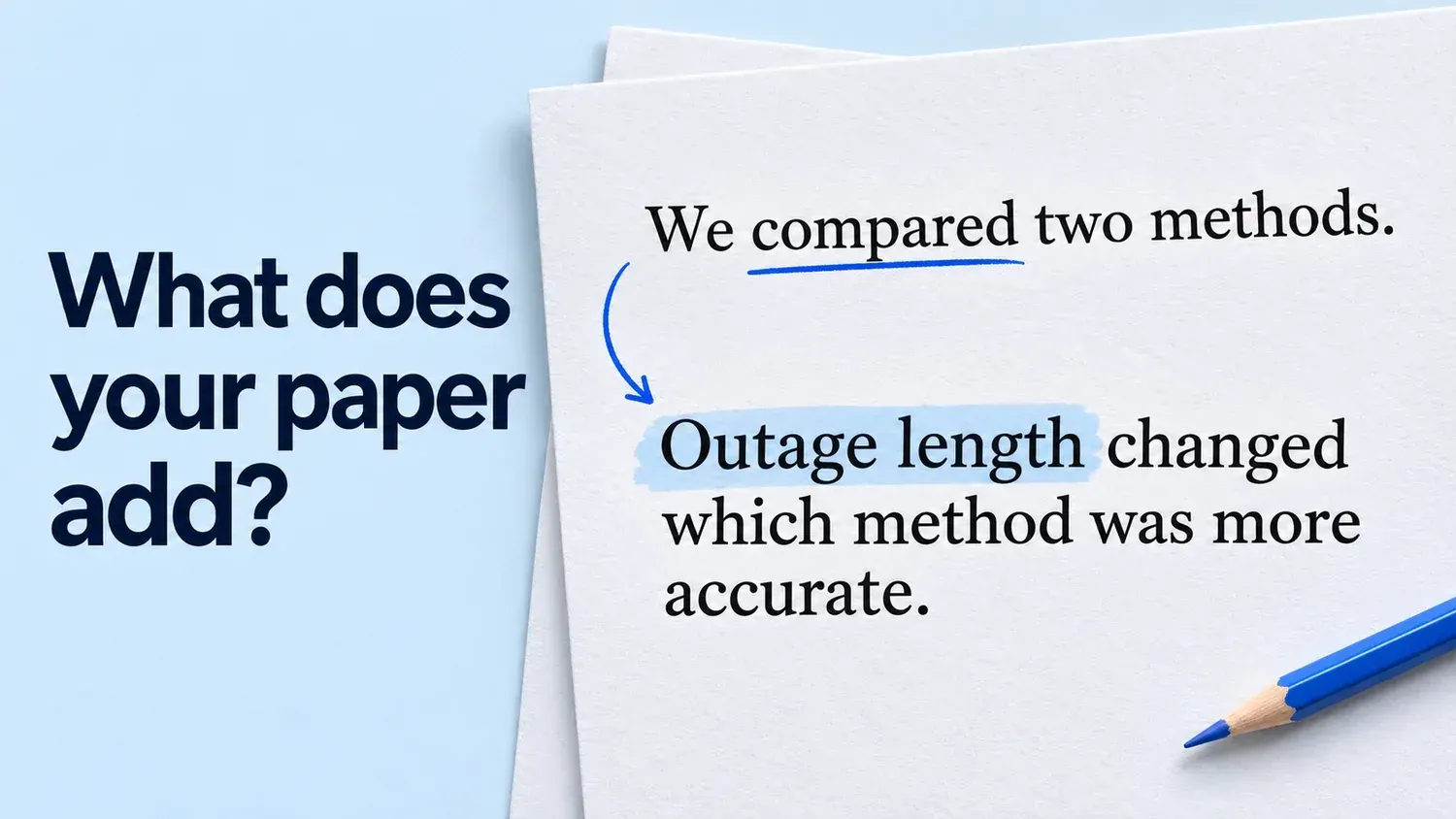
A good way to find a missing contribution is to ask what someone would cite your paper for. “They compared two methods for filling gaps in weather records” gives a colleague a topic. “The length of the outage changed which method gave the closer estimate” gives that colleague a reason to rethink how they test a method. The same study can earn either summary. Much depends on which sentence you give the reader.
A research contribution is the change in understanding or practice that your evidence supports. A contribution statement makes that change explicit. It identifies what readers could reasonably conclude before the study, what they can conclude afterward, and how far the evidence reaches.
Three places a research contribution gets lost
The introduction ends with an activity
Look at the main verb in the last sentence of your introduction. We interviewed, we developed, and we compared describe work you did. Try completing the sentence with what that work revealed. If the sentence could have been written before you collected the evidence, it probably still describes an aim. Keep the aim, then give readers the answer your study earned.
The literature gap names an empty space
“Few studies have examined small clinics” leaves a reviewer to guess why the setting matters. Which assumption from larger hospitals might fail in a two-person practice? Perhaps both settings have the same handoff policy, but only one has a second clinician on duty overnight. That difference gives you a reason to study the smaller setting and a concrete comparison to return to in the discussion.
The strongest finding is hiding in the results
Sometimes the sentence you need is already beneath Figure 3. Read your figure captions and the opening lines of your results paragraphs without the introduction. Which finding would change a colleague’s prediction or decision? Put a star beside it. Then check whether a reader who stops at the abstract would ever learn it. Mensh and Kording describe how organizing results around a central contribution lets readers follow the evidence through a paper. Read their paper-structuring guide in PLOS Computational Biology.
A contribution statement before and after revision
Imagine a team with one summer of hourly temperature readings from six urban weather stations. To test how well two methods fill gaps, the team hides known readings, estimates them, and checks the estimates against the originals. Some gaps last one hour. Others last six hours in a row. The study and its findings are fictional.
First draft
We compare two methods for filling gaps in weather-station records and discuss the implications for environmental monitoring.
Revised contribution statement
Across six urban stations in one summer, linear interpolation gave the lower mean absolute error for isolated missing hours. For six-hour gaps, using the previous day’s temperature at the same hour gave the lower error. Testing only isolated gaps would have reversed our choice of method for a six-hour outage.
The last sentence does the work. A researcher planning a benchmark can act on it by including outages of the length their sensors actually experience. The qualifiers matter, too. The team simulated gaps in summer records. An ice storm that knocks instruments offline raises a question these data leave open.
How to write a contribution statement from your own results
- Choose the closest comparison. Find the earlier paper, accepted explanation, or routine decision your reader would start from. Write down exactly what it already establishes. For a replication, identify the uncertainty that makes another test worth doing.
- Point to the evidence. Open the figure, quotation, proof, or comparison that earns your claim. If the evidence is an interview, a verb such as described may be more accurate than caused. If the claim concerns accuracy, name the error measure and the comparison method.
- Finish the reader’s sentence. Try writing “Given this result, someone doing ___ would now ___ because ___.” Fill the middle blank with a decision or an interpretation. “Include six-hour outages in the benchmark” works. “Appreciate the importance of monitoring” still leaves the reader looking for the change.
- Find the edge of the claim. Name one setting, population, or case where applying it would be a guess. Move the relevant qualifier into the statement itself, close to the finding it limits.
If you need a starting sentence, try this and then rewrite it in your field’s language.
Earlier work leaves open whether [specific uncertainty]. In [setting], we found [result] when we compared [A and B]. This changes how [reader] can [interpret, estimate, or choose something specific].
Where should the contribution appear in a manuscript?
In the introduction, put the closest prior finding next to the question it leaves open. In the weather example, the hinge is whether a method that works for one missing hour also works across a sustained outage. For help building that transition, see the Gatsbi guide to structuring a research paper introduction.
In the abstract, make room for both the result and its meaning. Nature’s annotated summary offers a useful editing exercise. Underline your main result, then circle the words explaining how it changes the reader’s understanding. If both marks land on “we compared,” you have found the sentence to revise. See Nature’s annotated summary paragraph (PDF).
In the discussion, return to the comparison you opened with. Explain which inference the result supports and where that inference runs out. Someone choosing a sensor test can use the summer example. Someone choosing a method for winter equipment failures still needs winter evidence.
Can a replication or a null result be a contribution?
Yes. A replication can show how well an earlier estimate holds up in a different setting or with a more precise measurement. Identify the original finding, explain why it deserved another test, and report what your estimate adds. PLOS One explicitly asks replication authors to discuss the earlier research and the scientific rationale for repeating it. Read the PLOS One publication criteria.
For a null result, look at the range of effects compatible with the data. An estimate precise enough to rule out a difference large enough to change practice can settle a practical question. A wide interval that includes meaningful effects in either direction leaves that question open. Stating which situation you have gives a reader more information than the phrase “no significant difference.”
Before you submit, give a colleague only the abstract and ask, “What would you cite this paper for?” Compare their answer with the sentence you starred in the results. When they can name the finding and the condition under which it holds, the contribution is visible on the page.